Shiba Roy
What “Over-The-Top” Really Means (And Why It Matters)
Have you watched Netflix today? Or maybe caught a show on Amazon Prime Video, Disney+, or YouTube? Then you’ve already used an OTT platform, even if you didn’t know it had a name. OTT full form is Over-The-Top. And it’s not just a tech term for streaming nerds. It’s actually the reason you haven’t needed a cable box in years.
What Does OTT Stand For?
OTT stands for Over-The-Top, and the name actually makes sense when you think about it. In other words, OTT goes over the top of traditional cable and satellite infrastructure to deliver content straight to your device via the internet.
So there’s no need for a set-top box, no cable contract, no technician knocking on your door. Just an internet connection and a screen.
How Does OTT Work?
Traditional TV pushes the same content to every viewer at the same time. You watch what’s on, when it’s on, or you miss it. OTT flips that completely.
With OTT, content is stored in the cloud and streamed to you on demand. So you choose what you watch, when you watch it, and on which device. Whether that’s your smartphone during a commute, your laptop in a café, or your smart TV at midnight, OTT doesn’t care. In fact, the platforms you already use every day, Netflix, YouTube, Hulu, Disney+, and Amazon Prime Video, are all OTT services. And let’s face it, you’ve been using OTT for years without even calling it that.
Types of OTT Platforms
Not all OTT services work the same way. Here’s how they differ:
SVOD (Subscription Video on Demand): You pay a monthly fee for unlimited access. Netflix and Disney+ are the best-known examples, though platforms like Apple TV+ and HBO Max also operate on this model.
AVOD (Ad-Supported Video on Demand): Free to watch, funded by ads. Think YouTube and Peacock’s free tier. Since there’s no subscription cost, AVOD works especially well in price-sensitive markets.
TVOD (Transactional Video on Demand): Pay-per-view, like renting a movie on Apple TV or Google Play. So instead of a recurring fee, you pay only for what you actually watch.
FAST (Free Ad-Supported Streaming TV): Free live TV channels streamed online, like Pluto TV. While it looks like traditional TV, it’s delivered entirely over the internet.
Most major platforms now offer a mix of these models, giving you options at different price points. And because viewer habits vary so much, that flexibility is no longer optional; it’s expected.
Why OTT Is a Big Deal Right Now
The numbers tell the story.
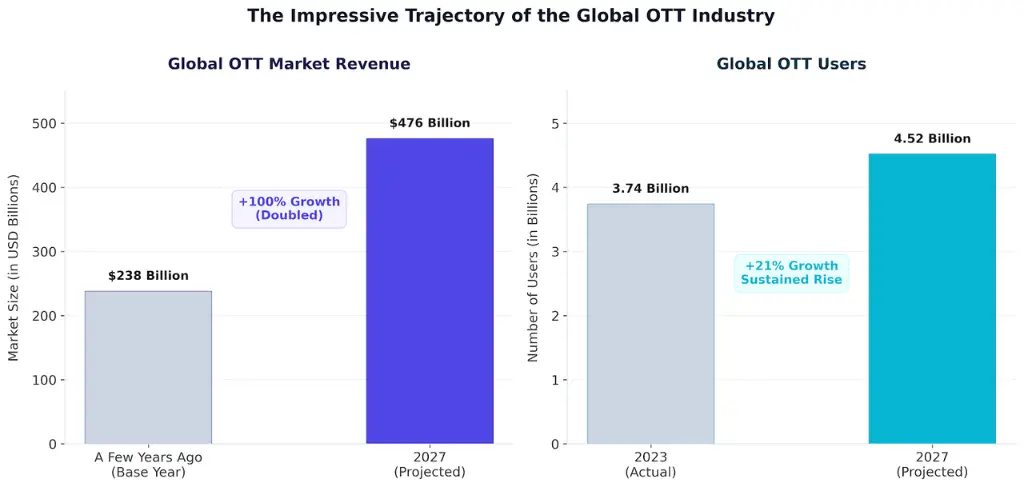
OTT users worldwide reached 3.74 billion in 2023 — and that number keeps climbing. Meanwhile, the global OTT market is projected to hit $476 billion by 2027, up from $238 billion just a few years ago. That growth didn’t happen by accident. It happened because OTT solved the biggest frustration with traditional TV: you had no control.
OTT handed control back to the viewer. Watch what you want, when you want. On whatever device is in your hand right now. That shift is why cord-cutting is no longer a trend; it’s the default.
The Key Differences between OTT and Traditional TV
| Traditional TV | OTT | |
| Delivery | Cable/satellite | Internet |
| Schedule | Fixed broadcast times | On demand |
| Devices | TV only | Smartphone, laptop, tablet, smart TV |
| Personalisation | None | AI-powered recommendations |
| Contract | Long-term | Flexible / cancel anytime |
| Cost | Fixed bundle | Choose your plan |
Traditional TV locks you into a package with 300 channels you’ll never watch. OTT, on the other hand, lets you pay for exactly what you want and cancel the moment you don’t.
FAQs About OTT Full Form
OTT’s full form is Over-The-Top. It refers to any service that delivers video, audio, or other media content over the internet, while bypassing traditional cable or satellite television providers entirely.
The most popular OTT platforms include Netflix, Amazon Prime Video, Disney+, YouTube, Hulu, HBO Max, and Apple TV+. In regional markets, platforms like JioCinema, Hotstar, and Zee5 are also major OTT players. So whether you’re in North America or South Asia, you’re never far from an OTT service.
No, OTT isn’t limited to video. The term also covers audio streaming (like Spotify and Apple Music), messaging services, and voice-over-IP calls. But in common usage, OTT almost always refers to video streaming, since that’s where the biggest platforms and audiences live.
They’re closely related, but not identical. Streaming is the technology; it’s how content is delivered in real time over the internet. OTT, however, is the business model. In other words, it’s the type of service that uses streaming to bypass traditional broadcast TV.
No special hardware required. OTT works on any internet-connected device, your smartphone, laptop, tablet, smart TV, gaming console, or streaming stick (like Roku or Amazon Fire TV). So if it connects to the internet, it can most likely run OTT content.