Shiba Roy
What Is SVOD? The Definition You Actually Need
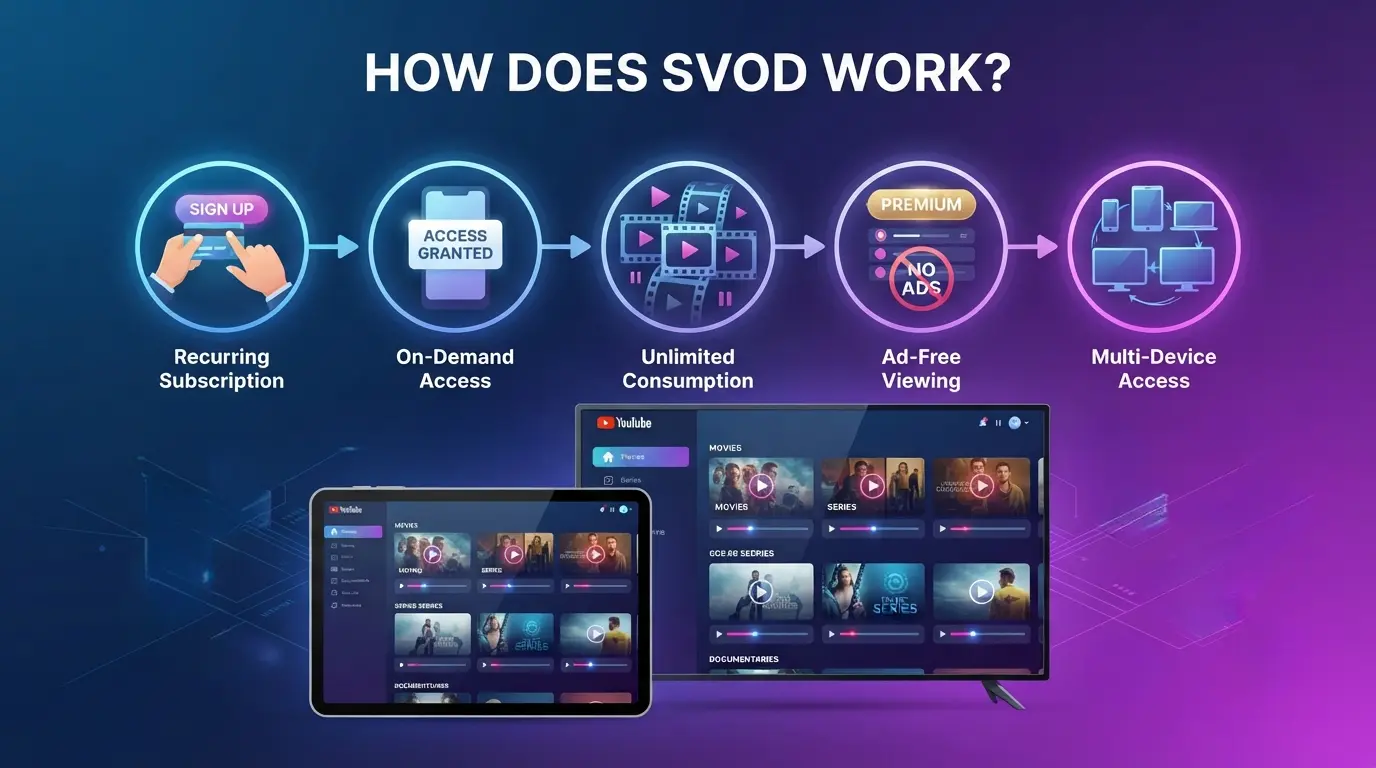
SVOD stands for Subscription Video on Demand. It’s a streaming model where viewers pay a recurring monthly or annual fee to get unlimited, on-demand access to a content library, with no broadcast schedules, no pay-per-title fees, and no cable contract.
| SVOD is the Netflix model: one flat fee, watch anything, anytime, on any device.
That’s the definition at its simplest. Here’s what it means in practice.
When someone subscribes to an SVOD platform, they’re not buying a specific show or movie. They’re buying access to the entire library, for as long as they keep paying. The moment they cancel, access ends. No refunds, no contracts, no strings.
For viewers, that’s an incredibly low-commitment way to consume a massive amount of content. For platforms, it creates a predictable, recurring revenue stream that compounds as the subscriber base grows.
SVOD has historically been associated with ad-free viewing, though that definition has become messier; many major platforms now offer both ad-supported and ad-free tiers. But the core mechanic remains the same: pay a subscription, get the library.
How Does SVOD Work?
The mechanics are very simple. A viewer signs up, enters their payment details, and immediately gets access to everything on the platform. Content is delivered via the internet, streamed directly to their device using the same OTT infrastructure that powers all modern streaming.
Here’s what happens on the platform side:
- Content is acquired or produced — either through licensing deals with studios or by investing in original programming
- A paywall gates the library — non-subscribers see a signup prompt instead of content
- Subscriptions auto-renew — monthly or annually, until the viewer cancels
- The platform uses data — viewing history, watch time, and preferences feed recommendation algorithms that keep viewers watching longer
That last point matters more than most people realize. With subscriber growth slowing and competition for audiences intensifying, the most successful SVOD platforms are leveraging big data and AI-driven analytics to improve customer satisfaction and retention. Keeping a subscriber is now just as important as acquiring one.
And it works. Average daily streaming time has reached 2.7 hours per user globally, up significantly from just a few years ago.
The 5 Key Features of SVOD Platforms
Not every streaming platform is an SVOD service. Here’s what makes a platform genuinely SVOD:
1. Recurring subscription fee: Viewers pay on a regular cycle like monthly, quarterly, or annually. The fee grants full access to the content library for the duration of the subscription. No surprises, no extra charges per title.
2. On-demand access: No broadcast schedules. No waiting for a specific time. Subscribers watch what they want, when they want, on whichever device they’re holding. That freedom is the whole point.
3. Unlimited content consumption: Once subscribed, there’s no cap on how much a viewer can watch. Whether that’s one episode a week or an entire series in a weekend, it’s all included.
4. Ad-free viewing (traditionally): SVOD was built on the promise of uninterrupted content. While many platforms now offer hybrid ad-supported tiers at lower price points, the premium SVOD experience has always been commercial-free.
5. Multi-device, multi-profile access: Most SVOD platforms let subscribers create multiple profiles under one account, useful for households with different viewing preferences and access content across phones, tablets, laptops, smart TVs, and gaming consoles.
These five features are what separate SVOD from every other streaming model on the market.
The Difference Between SVOD, AVOD, and TVOD
Here’s where a lot of people get confused. So, let’s clear it up.
There are three main video-on-demand monetization models, and each works differently:
| SVOD | AVOD | TVOD | |
| Full form | Subscription Video on Demand | Advertising Video on Demand | Transactional Video on Demand |
| How it’s paid for | Monthly/annual subscriber fee | Free to watch, funded by ads | Pay per title (rent or buy) |
| Ad experience | Ad-free (or low-ad tier) | Ads before and during content | Ad-free |
| Content access | Full library, unlimited | Full library, unlimited | One title at a time |
| Examples | Netflix, Disney+, HBO Max | YouTube, Pluto TV, Tubi | Apple TV rentals, Google Play |
| Best for | Regular, engaged viewers | Casual, price-sensitive audiences | New releases, one-off titles |
The core difference comes down to who pays. With SVOD, viewers pay directly through subscriptions. With AVOD, advertisers fund the viewing experience. TVOD sits in its own lane: viewers pay per title, similar to renting a movie the old-fashioned way.
In practice, though, the lines are blurring fast. Most major streaming platforms now operate as a mix of all three. Netflix has an ad-supported tier. Amazon Prime Video offers both subscription access and pay-per-title purchases. Peacock runs on all three models simultaneously.
That’s the hybrid era, and we’ll get to that shortly.
SVOD Examples: Platforms You Already Know
Let’s make this concrete. Here are the biggest SVOD services operating right now, and what makes each one worth studying.
Netflix: The platform that made SVOD mainstream. Launched in 2007, Netflix is the world’s largest SVOD streaming service with nearly 270 million subscribers globally. Its investment in original content. Stranger Things, The Crown, and Wednesday set the standard every other platform now chases.
Disney Plus: Built on one of the deepest content libraries ever assembled. Marvel, Star Wars, Pixar, Disney classics, and National Geographic, all under one subscription. In some markets, it’s already overtaking Netflix in subscriber numbers.
Amazon Prime Video: Unique because it’s bundled with Amazon Prime membership, making it a passive SVOD subscription for hundreds of millions of people who might not even think of themselves as streaming subscribers.
HBO Max (now Max): Positioned as the premium tier of the streaming wars. HBO’s prestige content combined with Warner Bros.’ film library justifies a higher price point than most competitors.
Apple TV Plus: The smallest content library of the major players, but consistently one of the most critically acclaimed. Ted Lasso, Severance, The Morning Show: quality over quantity.
Regional SVOD platforms: Beyond the global giants, regional players like JioCinema, Hotstar, Zee5, Voot, and iQIYI serve enormous markets with localized content that Netflix can’t replicate. Between 2023 and 2025, over 20 regional streaming platforms launched globally, each offering locally produced content libraries.
Why the SVOD Market Is Still Growing
Let’s face it: with so many streaming services competing for the same wallets, you’d think SVOD growth would be slowing down.
It isn’t.
Global SVOD subscriptions surpassed 1.8 billion in 2025, with the market valued at $37.4 billion and projected to reach $55.5 billion by 2035. Meanwhile, SVOD holds 58.2% of the global VoD market share, more than AVOD and TVOD combined.
So why does it keep growing despite subscription fatigue, rising prices, and fierce competition?
Three reasons, and they are
Original content creates must-have moments: When a platform produces the show everyone is talking about, and you can only watch it there, it becomes a subscription you can’t cancel. Netflix invested $13 billion in original content in 2023 alone. That kind of spend creates cultural events that drive sign-ups and retain subscribers.
Emerging markets are still early: Asia-Pacific accounts for 44% of new SVOD subscriber additions, driven by rising smartphone penetration, falling data costs, and populations with limited prior access to quality entertainment. India alone has over 900 million internet users and streaming penetration still below 12%.
The price-to-value perception holds: Compared to a cable TV package with channels you’ll never watch, even a $15/month SVOD subscription feels like a bargain. That perception keeps churn rates manageable even as platforms raise prices.
Is SVOD the Right Monetization Model for Businesses?
Here’s where it gets interesting for StreamAct readers.
SVOD isn’t just for Netflix. It’s a monetization model that any content creator, media company, or business with a content library can adopt. Fitness platforms, online education providers, niche entertainment networks, faith-based content- all of them can run on SVOD.
So, when does SVOD make sense for your platform?
Choose SVOD if:
- You have a large enough content library to justify ongoing access fees
- Your content is updated or refreshed regularly, so subscribers have a reason to stay
- Your audience values convenience over ownership. They want access, not a purchase
- You want predictable, recurring revenue instead of one-time transactions
Think twice about SVOD if:
- Your content library is thin, or a small catalogue doesn’t justify a subscription
- Your content has a finite shelf life. Examples: if someone watches everything in a month, they’ll cancel
- Your audience is extremely price-sensitive. AVOD or a hybrid model may work better
The SVOD model rewards consistency. The more consistently you add value, the lower your churn. And lower churn is everything in subscription businesses.
The Hybrid Shift: SVOD Is Evolving
Here’s something worth knowing: the SVOD model you learned about five years ago isn’t the SVOD model operating today.
Deloitte’s 2026 Digital Media Trends research found that 68% of SVOD subscribers now have at least one ad-supported tier, up from 46% in 2024. That’s a fundamental shift, and it changes the economics of the entire model.
Why the shift? Subscriber growth has slowed in mature markets. Platforms need new revenue streams. And millions of viewers would rather watch a few ads than pay a higher monthly fee.
So now, most major SVOD platforms offer tiered pricing:
- A premium ad-free tier, the traditional SVOD experience, higher price
- A lower-cost ad-supported tier: SVOD with limited ads, lower price
- Sometimes a free tier, AVOD-style access to attract new users before upselling
For platform builders, this is actually great news. It means you don’t have to choose between SVOD and AVOD from day one. You can build a hybrid model that captures both subscriber revenue and advertising revenue, serving different audience segments at different price points.
That’s the direction the entire industry is moving. And platforms that embrace it early have a structural advantage.
| Perspective | Pros | Cons |
| Viewers | – Unlimited access for a fixed, predictable cost – No ads (on premium tiers) – Watch anytime, anywhere, on any device – No long-term commitment | – Subscription fatigue from multiple platforms – Content fragmentation (not all shows are available everywhere) – Rising subscription rates |
| Platform Operators | – Predictable, recurring, compounding revenue – Direct viewer relationship & data ownership – Churn managed via content & UX strategies – High scalability (low marginal cost per subscriber) | – Constant need for high-value content investment – Fierce competition requiring niche positioning – High subscriber acquisition costs |
FAQs About SVOD
SVOD stands for Subscription Video on Demand. It refers to a streaming model where viewers pay a recurring fee, usually monthly or annually, to access an unlimited library of video content on demand, without being tied to a broadcast schedule.
The difference comes down to who pays for the content. With SVOD, the viewer pays through a subscription fee and typically gets an ad-free experience. With AVOD (Advertising Video on Demand), the content is free to the viewer but funded by advertisers who pay to place ads before or during the content. YouTube’s free tier is AVOD. Netflix’s standard plan is SVOD.
The biggest global SVOD platforms include Netflix (approx. 270 million subscribers), Amazon Prime Video (approx. 220 million), Disney+ (approx. 154 million), Apple TV+, and HBO Max. Regional leaders include JioCinema, Hotstar, and Zee5 in South Asia, and iQIYI and Tencent Video in China.
Yes, and more easily than you might think. White-label OTT platforms like StreamAct let you launch a fully functional SVOD service without building the technology from scratch. You bring the content; the platform handles subscriptions, payments, streaming, and analytics.
Not exactly. OTT (Over-The-Top) is the delivery method for any content delivered over the internet, bypassing traditional cable or satellite. SVOD is a monetization model, a type of OTT service where access is funded by subscriptions. All SVOD platforms are OTT, but not all OTT platforms are SVOD.
A hybrid SVOD model combines subscription revenue with advertising revenue. Platforms offer multiple tiers, typically a premium ad-free subscription and a lower-cost ad-supported subscription to capture different segments of the market. Netflix, Disney+, and Peacock all operate hybrid models today.